
Review Article
DownloadEpineural Theory of Consciousness: Two Thought Experiments and a Preliminary Hypothesis
Abdulwahab F. Alahmari
Radiology Department, Al-Namas General Hospital, Ministry of Health, Al-Namas City, Saudi Arabia.
Article Info
Received Date: 21 June 2024, Accepted Date: 28 June 2024, Published Date: 01 July 2024
*Corresponding author: Abdulwahab F. Alahmari, Radiology Department, Al-Namas General Hospital, Ministry of Health, Al-Namas City, Saudi Arabia.
Citation: Abdulwahab F. Alahmari (2024). “Epineural Theory of Consciousness: Two Thought Experiments and a Preliminary Hypothesis”. International Journal of Case Reports and Case Research, 1(1); DOI: http;//doi.org/06.2024/IJCRCR/002.
Copyright: © 2024 Abdulwahab F. Alahmari. This is an open-access article distributed under the terms of the Creative Commons Attribution 4. 0 international License, which permits unrestricted use, distribution, and reproduction in any medium, provided the original author and source are credited.
Abstract
The only problem that is called hard is the hard problem of consciousness, and one of the hardest words to be defined is consciousness. Some authors think consciousness is perception, alertness, being awake, understanding the world, give meanings, understanding the meaning of things in social context, etc. What if we take away all these signals? What will happen? Are you still conscious without them? Can consciousness be defined using this approach? Thomas Nagel asks, “What is it like to be a bat?” And John Searle asks, can we be tricked by a man who does not know the Chinese language in a room sending Chinese texts, so we think this person understands Chinese? Frank Jackson asks, Can Mary know everything in her black-and-white room? This paper will give a definition of consciousness using two thought experiments to isolate consciousness alone from other stimuli.
Keywords: consciousness; the dark room thought experiment; the zombie thought experiment; epi-neural theory of consciousness; mind.
Introduction
In order to make a theory that can explain consciousness, we have to define consciousness first. There are many dictionaries with conflicting definitions. Many people define consciousness according to their views; for example, the localists say it is an electrical activity in the brain, and the globalists say it is a global broadcast. There is a possibility that both are correct at the same time [1]. Some believe that it is metaphysical, and some believe it is an illusion made by the material body. Other believe we are conscious by mistake. Many religions and cultures believe in different spiritual things. Many languages describe the spirit, soul, psyche, and mind in different words. In different cultures, the word might have some kind of connotation (i.e. both good or bad), like spirit in the English language, which means a dead persons ghost (bad), whereas in Islamic culture, it means an entity made of light and the highest form of existence (good).
In order to cut through all of these, we need a thought experiment to know what consciousness is. Many scientists and philosophers mix many words, and they think they are the same. There is no distinction between the spirit, soul, psyche, and mind. Similarly, they mix consciousness, awareness, alertness, wakefulness, perception, attention, cognition, comprehension, etc. This thought experiment will give a clear cut and a strong base to build on a theory of consciousness. Without this base, no theory can be built since everyone makes definitions for consciousness.
The Dark Room Thought Experiment
Imagine this is your first conscious experience that you remember in your life with no prior memories. Your body is in a dark room (no visual signal), we have a device that can cut the gravity in that room and make your body float in mid-air. We injected your body before waking up with a chemical (i.e. muscle relaxants) that will make you unable to move anything or talk. No sound, no smell, no visual input, no sensation, and the room is not cold or hot (i.e. at average room temperature); therefore, there are no details to remember. Floating in the middle and center of the room. In the air and in the darkness. You do not touch the walls, roof, or ground. You feel, but there is nothing to feel. You do not feel hungry, your bowels are relaxed, and your heart is relaxed. You do not feel you have any voluntary or involuntary movements (i.e. urinate or defecate). You do not feel itchy, have hiccups, or any other feeling. You cant move or talk. No details to pay attention to. There is no signal to perceive it with your senses. You are not aware of your surroundings. Just darkness. No auditory, visual, olfactory, or taste signal coming in, see (Figure 1). In this state, are you conscious? This thought experiment isolates consciousness alone. Consciousness is the state of being existent mentally or having a mental life. Are you aware of your surrounding? There is nothing to be aware of! So, consciousness according to this experiment, is not perception or attention as (Dennett, 1993; Koch, 2004) confuses them.
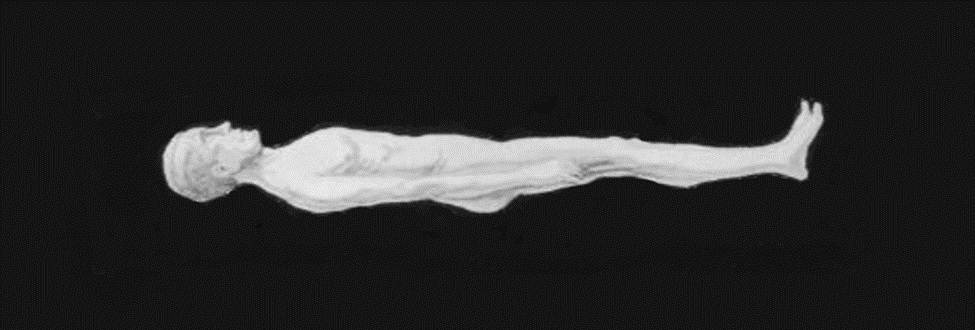
Figure 1: An illustration of The Dark Room Thought Experiment. Your body is in a dark room, no gravity, not able to move, you are fixed in the mid-center of a room, floating (not touching the ground, the walls, or the roof), no smell, no voices, no taste, no ability to talk, no sensation, at a normal room temperature (not hot or cold), no previous memory (no autobiographical memory), and no details to pay attention to or to remember (no working memory). Not thirsty or hungry. Relaxed and injected with muscle relaxants. Are you conscious? Do you exist mentally? Do you have a mental life?
What is the meaning of consciousness in this thought experiment? Are you in a state of existence mentally? It does not mean perception of a signal or attention to details. It does not mean social awareness or comprehension (making sense of perceived signals and their meanings). Consciousness does not mean being awake or aware. It means you are in a mental state of existence, nothing more or less. They speak about the Chinese room (to draw line between human and computers in term of consciousness), Mary in her colorless room (to highlight presence of qualia and affirm physicalisms mistake (reductionism)), or what is it like to be a bat? (to highlight qualia). The Dark Room Thought Experiment is to define consciousness itself. In Robert S, Woodworths book of psychology in 1921, he added a subtitle as a study of "the mental life" (Woodworth, 1921), which is a good term to describe consciousness. Lets see how others define consciousness.
Definitions by Others
According to Merriam-Webster Dictionary, consciousness is defined as a higher level of mental function that allows the person to be in a state of being aware within oneself (Webster, 2002). Awareness is the 1st synonym of consciousness, and wakefulness is the 2nd according to the dictionary (Webster, 2002).
Consciousness (i.e. to many people) can mean many things, like being awake, not sleeping, but even in that state, the human brain is still working, or better to say, active (there are dreams, which is a state of existence in another world). Consciousness can mean being aware of something a memory, a problem, a political cause, an information, a self-status, etc.
There are similar issues in the English language where many words have a small distinction between them and they are being used in interchanging fashion, like the soul, spirit, psyche, and mind. Consciousness cant be defined in the English language because it is related to memories and subjective experiences (i.e. qualia). It has states, levels, and types.
The states of consciousness could be: clouding of consciousness, confusion state, delirium, lethargy, obtundation, stupor, dementia, hypersomnia, vegetative state, akinetic mutism, locked-in syndrome, coma, and brain death. Levels of consciousness are conscious, subconscious, and unconscious (Freud, 1915). Consciousness dimensions are phenomenological, semantic, the physiological, and the functional (Jonkisz, 2017).
There are 5 types of consciousness: 1) sensing and perceiving the surrounding environment and having the capacity to respond in appropriate manners; 2) an active capacity to sense and perceive; 3) being self-aware; 4) life experiences; and 5) being conscious of objects and items (Van Gulick, 2012). Others, like Schneider & Velmans (2017), describe types of consciousness as: 1) fringe consciousness; 2) core consciousness; 3) focal consciousness; 4) self-consciousness; and 5) access consciousness.
From a linguistic point of view, words like spirit, soul, psyche, body, mind, brain, consciousness, awareness, perception, cognition, wakefulness, alertness, and attention all exist in human languages. These words have been embedded in the roots of languages for thousands of years and mainly taken from religious texts since religions have been on Earth for 4000-3000 Before Common Era (BCE) (Britannica, 2022). Lets see some of these texts in (Table).
|
Arabic/Islam |
Hebrew/Judaism |
Sanskrit/Hinduism |
Syriac Aramaic/Christianity |
English/Science |
|
Nafs |
Nefesh |
Ātma |
Nephesh |
Self - Soul (soul is a philosophical Greek-concept) |
|
Ruh |
Ruaḥ |
Ātman |
Rucha |
Spirit |
|
Eaql |
Neshama |
Śarīra |
khu: sha: ' wa: ia: |
Psyche - Mind |
|
Nafs |
Nefesh |
Ātma |
Nephesh |
Self - Soul (soul is a philosophical Greek-concept) |
|
Ruh |
Ruaḥ |
Ātman |
Rucha |
Spirit |
Table 1: Religions with different languages and have the same concept of the same word.
In languages, there are names for spirit, soul, and psyche in all religions. Even in religions like Buddhism, where spirit does not exist in that religion, but they have a word for it in Sanskrit and Pali. Notice in (Table), the three Abrahamic religions have some similarity due to being revealed in sematic languages in the words soul and spirit.
21-Gram Experiment
In order to know the difference in consciousness levels, we need to know the difference between three words: the self/soul, spirit, and psyche/mind. According to Duncan MacDougall Experiment in 1907, known as “the 21-Gram Experiment,” which found that animals have no souls (MacDougall, 1907). This experiment has two issues: 1) the definition of a soul and spirit is confused, 2) it has a small sample size. Some claim that the spirit is connected to the body, and this connection will make what is known as the soul. But it will be difficult to explain the 21-Gram Experiment following this definition. Therefore, spirit and soul are levels of sentience. This differentiation allows us to go along with the 21-Gram Experiment without any contradiction [2]. As a result, humans have a spirit and a soul, whereas animals have only souls. The 21-Gram Experiment will be for the spirit, not for the soul, because humans have spirits and animals do not. The result shows that there is a difference between these three entities based on the language evidence and the 21-gram experiment.
The Difference between Human and Animals Brains
Humans brains have three distinct features from animals brains: 1) the vertical orientation of humans brains vs. the horizontal orientation of animals brains see (Figure 2); 2) locus coeruleus [3] and the median reticular formation; and 3) the number of neuroglial cells in humans is 85 billion neuroglial cells vs 1.160 billion cells in monkeys, for example (Bahney, 2018). Neuroglial cells are important in human behaviors [4]. These three anatomical differences make humans able to understand and comprehend the meaning of different things, whereas animals work with an instinct. Some animals appear smarter than other animals due to having a higher number of neuroglial cells or developed small clusters of locus coeruleus. The result is that the local view is true to some extent.
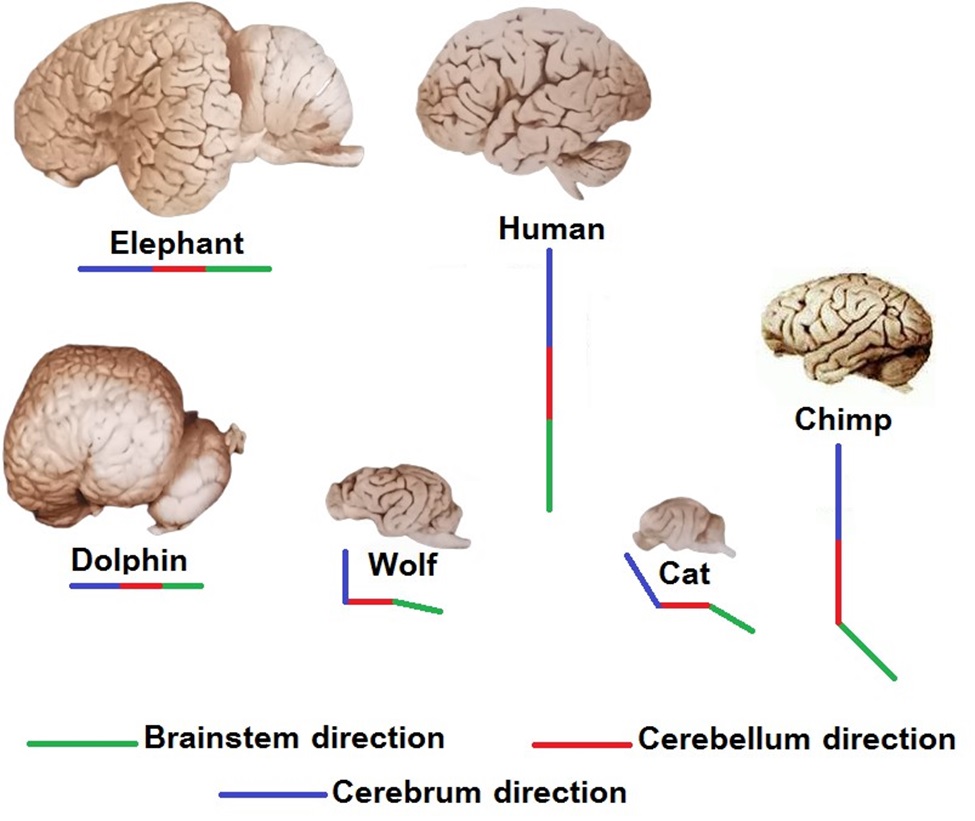
Figure 2: An illustration of the difference between humans and animals brains orientation.
The Zombie Thought Experiment
Lets imagine two people who live in two parallel and distinct worlds. One world where one of these people lives has only new tasks in a changing world. The other person lives in a steady state world where nothing changes, and this person does the same task all the time. The first person who lives in a changing world with new, different, and distinct tasks will lose memorization and the need for it. The person who lives in a steady-state world with routine tasks will lose the need and the ability for knowledge. New things are impossible in the fixed world, and routine things are impossible in the changing world.
Lets apply the Zombie Thought Experiment to humans here on Earth. Did we lose our memory or our knowledge? We did not, which proves we are not an automaton with reflexes, nor are we amnestic creatures like hamsters. For example, driving a car is really exhaustive in the beginning (you have headaches when you finish driving because the brain pays attention to too many things). After a while of learning to drive cars, the spinal cord takes over and lets the brain focus on the more important tasks.
Cognitive ability is like a muscle; use it or lose it. Therefore, not using a function will result in losing this function, whatever it is. The Zombie Thought Experiment shows that Danial Dennetts claim that we are an automaton is false.
Epi-Neural Theory of Consciousness: A Short Introduction
Genes used to be the center of explanation for all diseases and disorders until genes were found in many people in different environments and these genes did not express themselves, so epigenetic factors were discovered. Today, consciousness is similar to the times when the focus was on genes and epigenetic factors were neglected. Likewise, epineural factors could give explanations when neurons cant give answers. As well, before knowing electricity, the neural activity was unclear to humans (Eckoldt, 2016). Similarly, in Darwinian evolution, mutation was known before discovering DNA, but mutation was a word without meaning before knowing that genes exist. Following the same logic, undiscovered energy yet by humans that works as a global broadcast would be the logical explanation. For example, in many cases, people suddenly have inspiration to solve humans dilemmas (Andreasen, 2005). Nancy Andreasen showed in her book many cases of scientists, poets, artists, and Noble Prize winners, and they were asked: How did they come up with these ideas that solved these great obstacles? All answered that it was revealed to them as an inspiration. The inspiration phenomena will work only with a global broadcast station that works as a source of intelligence and sentience. There are other reasons, but they will be discussed in another paper that reveals a complete theory, which I like to call "the Epi-Neural Theory of Consciousness".
Many authors confuse consciousness, awareness, alertness, wakefulness, perception, attention, cognition, and comprehension all together. If humans are made by matter only, the matter will not be aware of the material world, so we need something immaterial or unphysical to allow us to make sense of the material world. Since the Earth conserves its matter but not its energy. The Earth is a closed system for matter and an opened system for energy. For example, matter does not leave the Earth naturally, while the suns energy is allowed to enter the Earth and allow the heat to leave at night. As a result, the Epi-Neural Theory of Consciousness claims that unknowing energy enters the Earth, which does not contradict the Law of Conservation of Energy. Descartes claims that the psyche is responsible for thinking and consciousness is the recording of thinking, which is wrong because that is the working memory. There are two types of conditions in philosophy: 1) a necessary condition, and 2) a sufficient condition. To explain the difference, lets give an analogy of a business deal. The necessary condition is having two parties, and the sufficient condition is having a contract, witnesses, down payment, etc. Without the necessary condition, there is no deal. Without sufficient conditions, the deal can be done, but it is not a perfect deal. Likewise, consciousness is a necessary condition for being aware, having cognition, having free will, etc. Consciousness is the state of being mentally existence or having a mental life. Consciousness is independent from anything else, but others like awareness, cognition, free will, and attention depend on consciousness.
Danial Dennett claims that consciousness is an illusion made by an evolutionary process as a mutation by randomness (mistake), and we are not supposed to be conscious! What does that mean? Because it looks like escaping from answering the question. Thomas Nagel admitted in his book that materialists and physicalists could not explain consciousness using the evolutionary paradigm (Nagel, 2012). Consciousness cant be proven, but we only can ask the person: Are you conscious? Thats why the Glasgow Coma Scale (GCS) depends mainly on the patients responses. We can look into someones eyes, and we know he is not there. Or that person passed away (i.e. the fixed and dilated pupil sign). We can see consciousness effects, but we cant see consciousness itself (i.e. the cause). We can entail that cause exists from having an effect following the rule; there is no cause without effect, even though, the law of entropy works in a closed system and consciousness as an energy works in an opened system. Consciousness has two possibilities: 1) being metaphysical, or 2) work using some kind of energy that humans have not yet discovered. In ultrasound imaging of the brain, the sound waves have a speed of 3000 m/s, which causes an aberration of the sound waves. Maybe the skulls job is to condense this unknown energy to allow the reception of the necessary signals that the human needs. In cases of craniectomy, the patients suffer from the Syndrome of Trephined, or “sinking skin flap syndrome,” which leads to neurological deterioration 24 – 48 hours after the removal of the cranial bone. This syndrome is very common among patients, which proves that the brain needs to be shielded and allow signal condensation, or better to say, “filtering” external signals. And without skull bones, humans fade away. Why does the skin not pup out; instead, it will be sucked in, why? This is strong evidence that supports the global broadcast, signal theory, or the Aether [5]. This Aetheral signal is coming from a parallel universe, and it is called in P. D. Ouspenskys book “the Fourth Dimension” (Ouspensky, 1923). The 40 Hz hypothesis made by Crick & Koch (1990), is evidence for signal condensation at the skull and it has nothing to do with the binding hypothesis (i.e. they were mistaken) [6]. The 40 Hz waves at the cortex can be explained in the epineural theory of consciousness as these waves are part of the amplified signal by the thick bones of the skull and received by the fingers like projections (i.e. gyri) of the brains cortex see (Figure 3). The convolution of the brains cortex is thought to be made this way in order to fit the brain in a small cavity of the skull [7], but the reality is, the formation of the brain like this was designed in order to be able to receive the global signal.
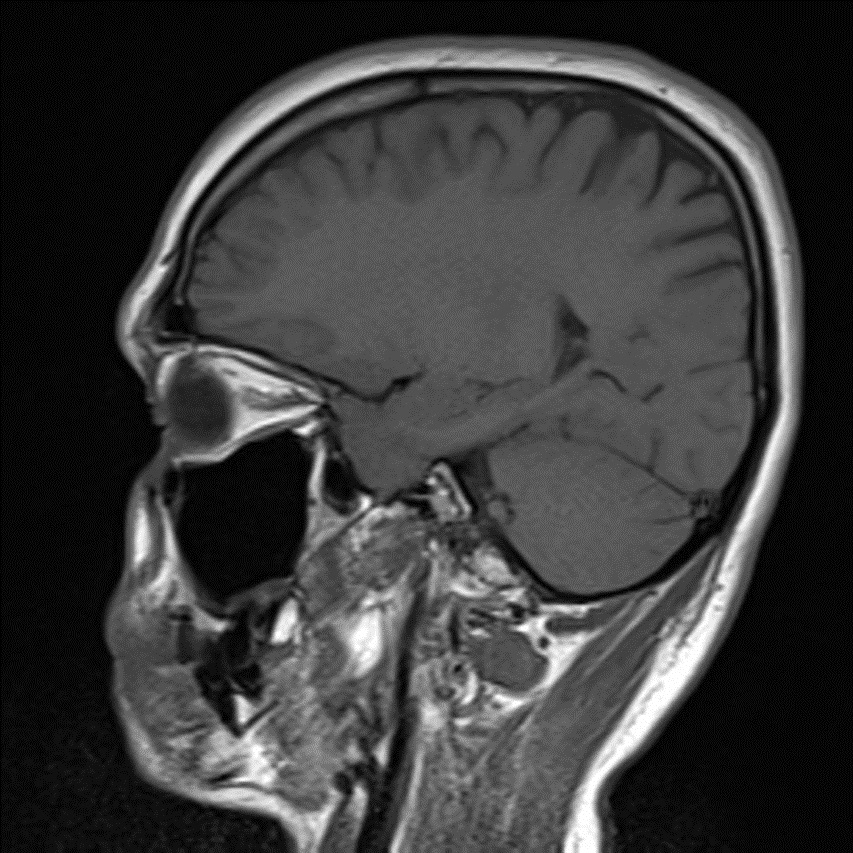
Figure 3: A brain coronal MRI shows a finger like projection of the brain cortex which is designed this way in order to receive the global signal after being condensed and amplified by the thick skull bones.
Some of the localists, like Koch (2004), claim that “consciousness is in the pyramidal cells” then he changed his mind to say, no, “consciousness is in the spindle cells”, then he changed his mind to say, “visual consciousness is in the dorsal pathway not the ventral pathway”, then he changed it to “the fusiform cortex”! This appears to be some kind of cognitive dissonance. To clarify the deference between consciousness, awareness, perception, cognition, and attention, this diagram will make a distinction between them see (Figure 4). Even in Kochs (2004) book, he describes consciousness eventually to occur in the synaptic cleft, which is outside the neurons, which explains why the theory of this paper is called “epineural”. The rule of neurons is exaggerated by “the Neuronians”, but today the glial cells have been proven to have bigger numbers and rules in behaviors than the neurons, which is another reason why the name of the theory in this paper is called “epineural” (Koob, 2009).
Many authors over-intellectualize consciousness. Here is the basis on which we will build any future theory of consciousness. There are three distinct entities: spirit, soul, and psyche. Consciousness is the state of being extant (i.e. having a mental life). Awareness is being aware of surrounding stimuli and their meaning in a social context [8]. Perception is receiving a physical signal without an interpretation of their meaning. Attention is focused on details based on their intensity. Cognition is having knowledge based on memories, external signal, or the analysis of information. Repeating cognition will be recognition or realization, which is another mental function. Comprehension is collecting all these functions and making sense of them to give them a human meaning. Having a spirit means having consciousness (mental life) and being sentient [9]. Being sentient is being aware, as seen (Figure 4). This word, "sentience," should be used to avoid any confusion. Even though, the name of the theory will remain the Epi-Neural Theory of Consciousness, the term is wrong [10]. Having a soul will mean having an instinctive nature which is the lowest form of being sentient.
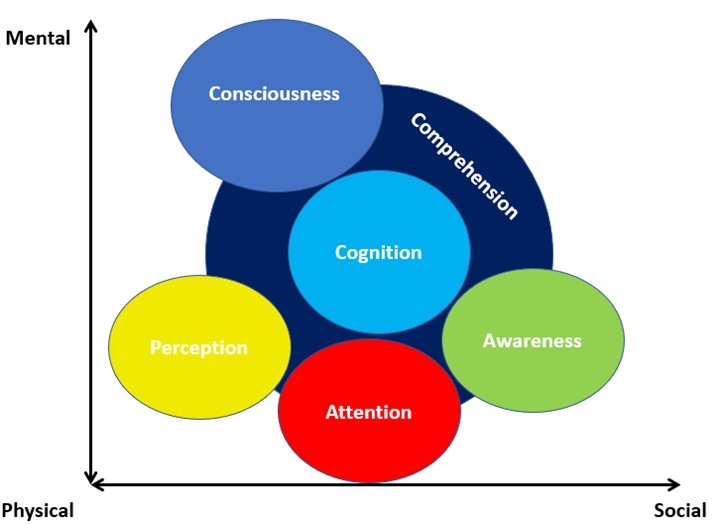
Figure 4: A diagram explaining the mental functions which show that consciousness is only a function of many functions that all partly lie within comprehension. Some parts lie outside of comprehension. In order to make sense of the reality in someone, that person will need to be in a state of mental existence (conscious) as a necessary condition. After that, having knowledge which is highlighted in the middle as cognition. As well, perception of a physical signal highlighted in perception. That person must pay attention to signals to recognize it, highlighted in attention. That person needs to be aware of the signal and what does that signal mean in a social context? Highlighted in awareness. All of these functions make that person able to comprehend the reality to grasp the meaning of things. Sentience is proposed in this paper, to be used as an alternative to what is meant by “consciousness” when these authors mention it (i.e. Danial Dennett and Christof Kock). What these authors speak about is they mean (being sentience), it needs attention, memory (autobiographical and working), perception, consciousness and comprehension. Sentience might need memory, meanwhile consciousness does not. Awareness is an overused word by the public (like awareness of dangers of smoking), so sentience here will be awareness on the diagram.
Conclusion
This paper proposes the use of the term "sentience" to avoid words like consciousness or awareness, for the previously explained reasons. In order to solve the mystery of consciousness, it must first be defined, since everyone makes up different definitions. Danial Dennett and Christof Koch confuse consciousness with attention and perception, then claim consciousness is an illusion. Define the subject that needs to be studied, then continue your investigation. They could not do that without The Dark Room Thought Experiment which shows that consciousness is something different than what these authors think it is.
References
Alahmari, A. (2024). Madness. Unpublished manuscript.
Andreasen, N. C. (2006). The creative brain: The science of genius. Penguin.
Blackmore, S. (2017). Consciousness: A very short introduction. Oxford University Press.
Dennett, D. C. (1993). Consciousness explained. Penguin UK.
Dictionary, M. W. (2002). Merriam-Webster. On-line at http://www. mw. com/home. htm, 8(2).
Eckoldt, M. (2016). A brief history of the brain and mind. Munich.
Freud, S. (1915). The Unconscious (standards edition). London: Hogarth.
Jackson, F. (1986). What Mary didnt know. The journal of philosophy, 83(5), 291-295.
Koch, C. (2004). The quest for consciousness. Engineering and Science, 67(2), 28-34.
MacDougall, D. (1907). Hypothesis concerning soul substance together with experimental evidence of the existence of such substance. Journal of the American Society for Psychical Research. 1(5), 237-275.
Searle, J. R. (1980). Minds, brains, and programs. Behavioral and brain sciences. 3(3), 417-424.
Ouspensky, P. D. (1923). Tertium organum: The third canon of thought; a key to the enigmas of the world. AA Knopf.
Van Gulick, Robert, Consciousness and Cognition, in Eric Margolis, Richard Samuels, and Stephen P. Stich (eds).
The Oxford Handbook of Philosophy of Cognitive Science, Oxford Handbooks (2012; online edn, Oxford Academic, 1 May 2012).